
Whitewashed Tombs
Idealizing those we’ve lost is a common responses to death. It also makes processing grief that much harder


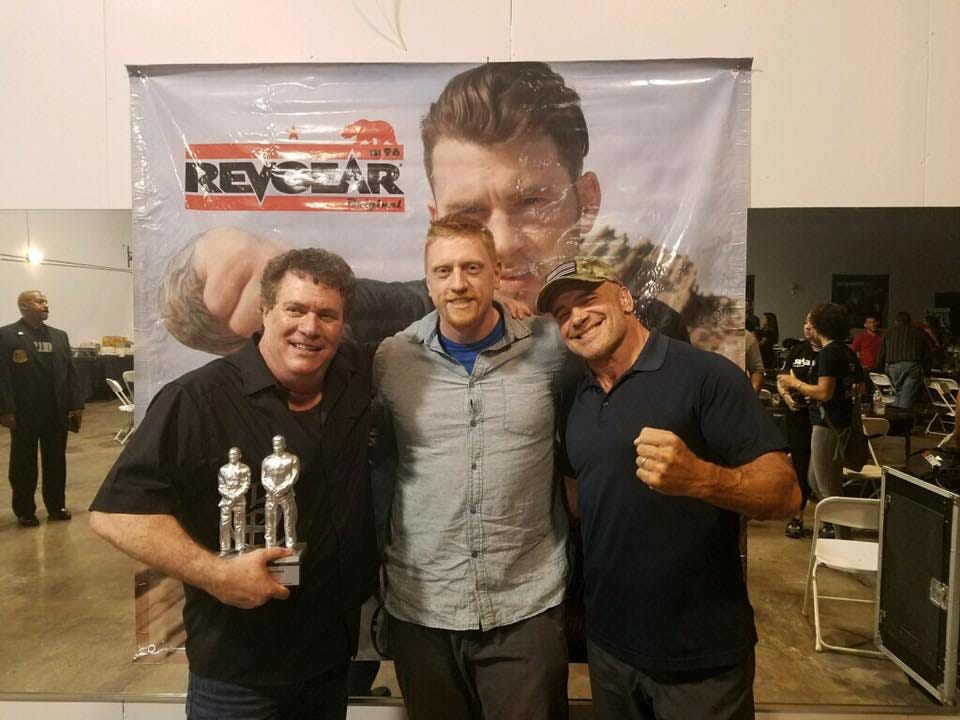
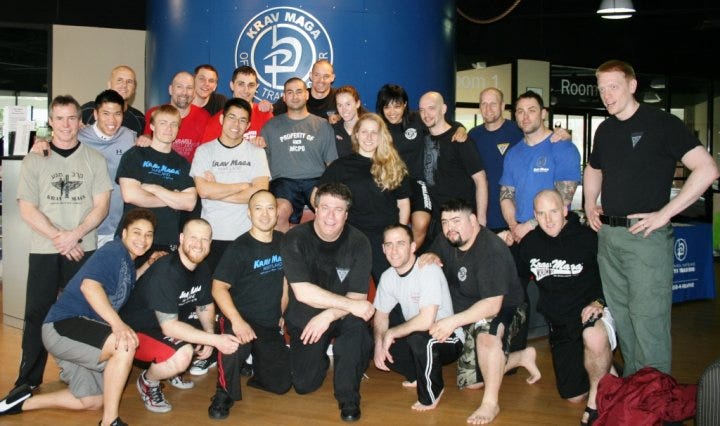
Yesterday, I lost a mentor and friend. Darren Levine, the man who brought Krav Maga to the US, died yesterday after a long series of health complications. He has touched tens of thousands of lives with his mentorship, his dedication, his teaching, and his humanity. There are many who list his legacy and contribution better than I, so feel free to peruse. The short version is this; Darren was the first American to ever train in Krav Maga with the self defense system’s creator, Imi Lichtenfeld. And he was such a standout that Imi entrusted the proliferation of Krav Maga in the US to Darren and his students. Tens of thousands of people – military, law enforcement, and civilians, are safer in their own skin because of Darren’s lifetime work with Krav Maga.
Outside of martial arts, Darren’s career as a prosecutor was equally impressive. Part of the LA County’s targeted crimes office, the bulk of Darren’s career was spent prosecuting gang members who had murdered police officers. He had arguably more forensic and legal knowledge than anyone in the country about the worst threats that law enforcement face in the course of their job.
Personal Impact
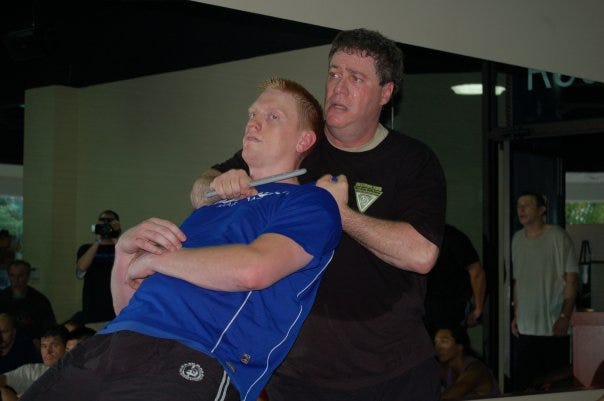
For me, Darren was singular in calling forth my talent and dedication. He intuitivey saw my passion for making people safer, and he fanned the flame. He saw my unique athletic and communication skills and exhorted me to develop them as much as I could. He had a contagious excitement when someone embodied principles of self-defense in the kinetic melee of training, and I received that spontaneous, “YES!” many times over my career. In my 20’s, he called me a “rising star” in front of a few hundred Krav Maga practitioners. My heart swelled at the approval of such a powerful mentor. He poured affirmation and challenge out to me in equal measure. He invited me to take risks building up my students, and he constantly acknowledged my own innovation as an instructor and a business owner.
Off the mat, however, was where I received even more gold from Darren’s place in my life.
One time I was in LA for an extended training trip. Darren texted me daily to ask how I was doing, and if I needed anything. Boldly, I was honest with my needs – I needed to do laundry! He coordinated his housekeeper to do my laundry and get it back to me. In retrospect I’m a little embarrassed by my forthrightness, but the support and care he gave overshadows it completely.
In 2016, the night my mother died from her own torturous struggle with alcoholism, he dropped everything and spoke with me for over an hour. He spoke of the death of his late wife Marni, and regrets he had about his own grieving process. He counseled me how to care for myself while also being a father, leveraging his own faults in service of supporting me.
As the Krav Maga community continues to grieve Darren, more stories are emerging like this. There are countless little generosities, blessings big and small, golden moments of investment and approval and connection. Darren was equally as caring and gentle as he could be fierce; I’ve seen him roar as he taught a roomful of military special operators, and I saw him smile and kneel to get eye-level with my twins when they were toddlers.
Struggle, Wisdom, and Paradox
But in the midst of all this, I’m struggling.
I’m struggling with distance, being on the opposite coast of the whole community surrounding Darren and his family. I’m struggling with flowery social media memorials, posted by people who betrayed Darren and his vision. There are so many who treated his investment and his mentorship cheaply, who chose self-promotion and deceit over loyalty and integrity. I’m also struggling with the hero worship; with those who are grieving the myth, not the man. There are so many people who clearly only interfaced with Darren superficially, and the one-dimensional nature of their engagement comes out in their words. I know it’s not my place to gatekeep, but with heartache running high, it’s not easy.
Luckily over the past two years I’ve met some amazing people who are very wise in the ways of grief (check out their own writings here and here). Some of their wisdom is emerging here. One of the lessons I’ve learned from them is that grief and self-deception do not go well together. My dad died when I was 21 of heart complications exacerbated by a lifetime of smoking. At the time, I had such an idealized view of him that I was unable to cope with the understanding of his human faults and failures. The dissonance was far from merely cognitive – it went to the core of my soul. I had no tools to process the hurt and anger stemming from his imperfections. The end result was that my grieving process was stalled, crystallized. As powerful, unexpressed feelings always do, they started to have a cannibalizing effect. I turned on myself with a host of self-destructive behavior.
Only when I was in a community of men who held space for both my gratitude and my anger did I begin to heal. I was able to separate out what mess I had inherited, and what mess I had generated. The paradox never really resolved – paradoxes aren’t meant to. But, I slowly recovered the parts of myself I had forfeited. I can now talk about the gold and the barbs at length without disrupting my peace or having any other lingering effect.
When my mom died many years later, it was much more painful. She was profoundly self-destructive with her physical, emotional, and spiritual health. I experienced many more angry, unequivocal rejections from her. Years more of drama, in and out of rehab, stints of sobriety and fragile trust that were violently smashed again and again. She never did get better. When she finally died, I was all in on validating my pain.
Most everyone around me bucked against this. They seemed dedicated to rewriting history, minimizing wounds, euphemizing some of the most traumatic experiences I’ve ever had. They talked me down, corrected me in public, even shamed me for my outward expression of anger. I wasn’t having it. For better or worse, I stood for the validity and dignity of my inherited pain. I’m not sure this was better, but it was sure as hell honest. And at the time, it felt really good to be so angry.
That is, until I no longer was able to recognize all the amazing gifts my mother gave me. I was so committed to validating my hurt and anger that I had no room for gratitude. At the time I was happy to ignore the fact that it was my mother who never said no to my requests to buy a book – any book. She never said no to any musical instrument I wanted to learn, no matter how outlandish. She said no to plenty of video games, TV, and movies. But she never said no to any sport, and got me to all the martial arts training and competition I requested. Even my deep connection to my Celtic heritage began with simple introductions from my mother.
It took me years to integrate gratitude and pain for both my parents. Part of the delay comes from my own resistance to difficult feelings. But part of it is also a cultural blind spot we all carry – an uphill battle to eek out space for conflicting feelings – all while everyone else wants our grief to be simple and unilateral.
Whitewashed Tombs
The term “whitewashed tombs” originally denoted religious hypocrisy – people who worked overtime to convince you of their holiness while rot and decay sat inside. I’m not using it in that manner. Rather, this phrase dominates my mind when I think of our disingenuous approach to death. We are the ones who whitewash the tombs of our dead. We rewrite history to distance ourselves from complicated tensions. In doing so, we lionize those who don’t need it, and jettison our own precious, but equally complicated, experiences. This makes grief even harder than it would otherwise be. And I’m more than a little sick of it.
I turn 44 in May. I don’t know what it says about me that I’ve tried to envision my own funeral several times. But I have no desire for people to idealize me in death. Currently I’m a convenient villain in enough people’s story. If I want my own full story to matter, how can I expect to censor others’? It matters when we hurt others. And the recipients of our misdeeds don’t magically heal on our death, so why should the recognition of the reality be any different?
Can we be courageous enough to be honest about the ways our loved ones have failed us? Can we create a philosophy of death that doesn’t require such intense compartmentalization and self-deception? Can we be with all of what surfaces in grief, no matter how inconvenient, or contradictory, or just plain tragic? I happen to believe that if we let people be their whole selves in death – warts and all – we alchemically give ourselves and everyone around us permission to be their whole selves in life.
Honesty and Love
So, because I loved Darren and received so much from him, I will be honest with myself and the world about his imperfections as I saw them.
Darren was often incredibly thin-skinned. He was quick to interpret disrespect or disloyalty, sometimes seeing affront and insult where none existed. Sometimes this became a self-fulfilling prophecy, wherein he alienated the very people he was afraid would betray him. Sometimes the loyalty he expected was reciprocated; many times it wasn’t.
Often Darren didn’t live in reality when it came to the state of his own health. No one really knew how much pain he was in or what he was able to do. This constant clash between hopeful self-deception and raw medical reality left a lot of people waiting at the station. Lunch dates, phone calls, even major training events were cancelled last-minute, often with no explanation. This, too, caused unnecessary rifts and destabilized otherwise tight, committed relationships.
Everyone close to Darren knew that he played favorites. There was a long time when I was one of them, and then there was a time where I very much wasn’t. This hurt, because it inevitably left people in my position wondering what they did to lose favor. It almost never had to do with the object of the favoritism – it was just part of the package of being in Darren’s life.
If any of this doesn’t sit well with you, consider what you may be avoiding within yourself by needing your own grief to be so linear. Consider the messy feelings in your own realm which you may have exiled. And consider that you may allow yourself to be more fully human by inviting the mess back to the table and chatting with it for a bit over tea.
Grieving the Whole Person
I’m sure there are many other human frailties of Darren that I’m not even aware of. This isn’t an exhaustive list and nothing about this recounting will be graded. Getting them all exactly right isn’t the point. The point is this; if we are to grieve a lost loved one, then let us grieve the whole person. Let us not divide a person up by our own shortsighted judgments and grieve the parts that are comfortable, or socially acceptable, or convenient. I love, have connected with, and been impacted by whole people, not idealized caricatures. Not whitewashed tombs. The open recognition of a person’s faults, if handled kindly, ought to magnify our love for them, and their love for us, even more. It solidifies the love, and the grief, in the realm of the real, rather than relegating it to fantastical revisionism.
I happen to believe, after much reflection, that Darren’s contribution to my life is powerful enough to shoulder whatever thorns he left me. I hope that’s true for everyone who is grieving. Let us not be blinded by starry-eyed naivete, nor sour-grapes bitterness. I reject the binary limitations of both; instead, I will sit sad, angry, and grateful in the paradox. I will do my best to learn how to hold this awkward, misshapen thing called grief in its entirety. It’s the only thing I know to do.
A very thoughtful and fitting and well penned memorial Jeff.
The naked honesty of this…still has me thinking of it hours after I first read it. Well done.